
Community
The Intellect of Nobility: Two Years of the Obiship of Dr. Henry Chukwuma Ajudua

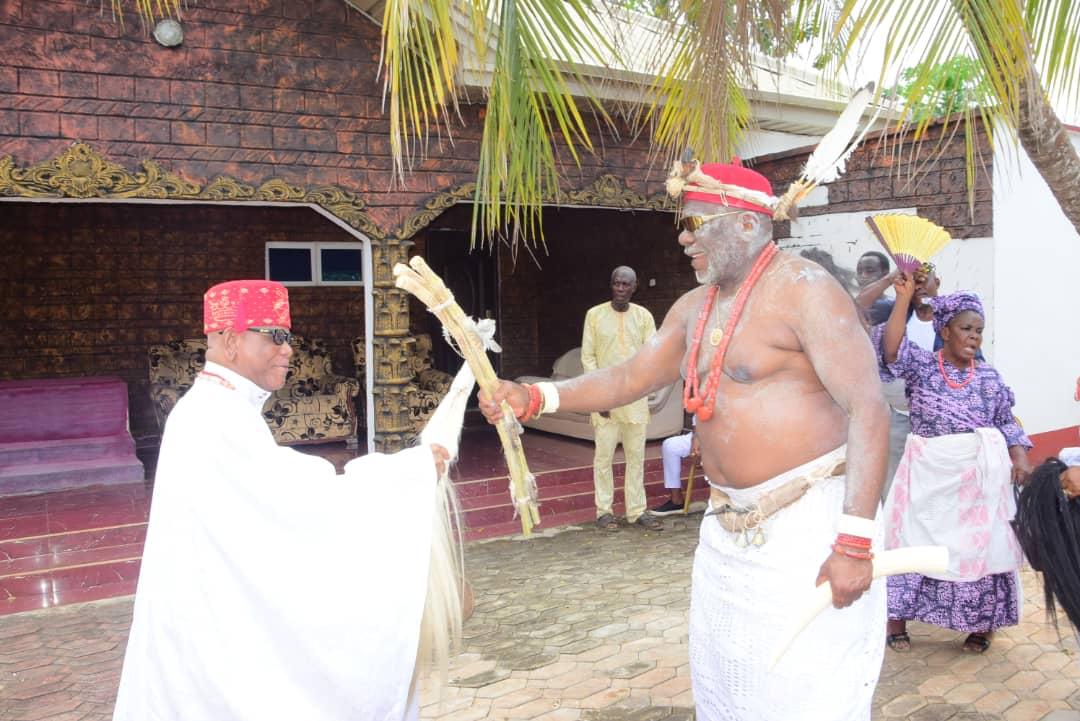
In the discourse of contemporary African sociology, the intersection between acquired professional intellect and inherited cultural responsibility often presents a delicate baseline.
For centuries, the structural preservation of identity has relied not merely on the existence of traditions, but on the caliber of individuals who step forward to anchor them.
Within the historic Igbuzo (Ibusa) Kingdom of Delta State, this delicate balance is currently finding profound expression.
The community is marking the second anniversary of the ascension of Obi (Dr.) Henry Chukwuma Ajudua (Obi Eze Udo of Igbuzo) to the highly revered patrician institution of Obiship—an elevation that occurred in late 2024 amidst deeply significant traditional rites.
To analyze this two-year milestone with intellectual honesty requires moving past the superficiality of mere pageantry to examine the substance of systemic impact.
As the great philosopher Aristotle famously noted, “Dignity does not consist in possessing honors, but in deserving them.”
In the institutional architecture of Igbuzo, where the Obuzor remains the sole paramount traditional ruler and sovereign custodian of the kingdom, the title of Obi represents an elite attainment of nobility, leadership, and communal stewardship.
It is a patrician pillar designed for those who possess both the material independence and the philosophical discipline to act as structural anchors for the society.
Over the last 24 months, Obi Dr. Henry Ajudua—a United States-based medical practitioner and corporate executive—has demonstrated that true nobility is an active verb rather than a passive status.
His tenure has lent credence to the timeless English proverb: “Actions speak louder than words.”
A society is fundamentally measured by how it shields its most vulnerable members. Long before he assumed his ancestral seat among the titled nobles of the land, Dr. Henry Ajudua understood that to whom much is given, much is expected.
Through the Vebron Carre Foundation, a humanitarian organization he leads alongside his counterpart, Obi Okpoho Dr. Vivian Onyebuchi Henry-Ajudua, he has established structured interventions that transcend the transient nature of typical philanthropy.
Where traditional governance spaces can sometimes feel disconnected from a modern, highly educated diaspora, Obi Eze Udo and his family have built a vital bridge. Operating with diplomatic discretion and a deep sense of patriotic duty, they have effectively leveraged their international medical expertise and corporate acumen to address local socioeconomic challenges. Under their stewardship, the foundation has institutionalized community development at the grassroots level. From sustaining comprehensive scholarship support for indigent students at the Omu Boys Primary School playground to executing critical food bank distributions and free healthcare initiatives, their focus has remained steadfastly on human capital development. By prioritizing sustainable empowerment over sporadic handouts, his noble seat has become an active catalyst for modern communal progress.
Furthermore, this impact is not localized; it represents a sophisticated model of cultural diplomacy.
Recently, at the 2026 CISA Annual Igbo Worldwide Festival of Arts and Culture in the United States, Obi Dr. Henry Ajudua and his wife were honored as Royal Guests of Honour and Cultural Ambassadors. There, on a global stage, they championed the preservation of Anioma cultural heritage and called for deeper historical consciousness among the diaspora.
This balance of local grounding and international representation underscores a vital truth: true patriotism recognizes that local development and global identity are two sides of the same coin.
To look back at the last 24 months is to witness the evolution of the Obiship into an engine for contemporary development, balancing absolute respect for the crown with an unyielding commitment to the people. Dr. Henry Chukwuma Ajudua’s two-year milestone proves that when academic brilliance, corporate exposure, and deep-seated cultural reverence converge, a community does not just preserve its past—it secures its future. As Igbuzo celebrates this milestone, the Federated Union of Community Newspaper Publishers of Nigeria stands as a witness to a legacy in the making: a leadership defined not by sovereign claims, but by the quiet, undeniable depth of its impact
Share this story
Get updates on WhatsApp
Subscribe to receive selected updates from Media Gate News Online. We only use your number for this publication, and you can unsubscribe later.