
Politics
Tinubu Taking Political ‘Bullets’ as States, LGAs Receive Increased Revenue — Bagudu
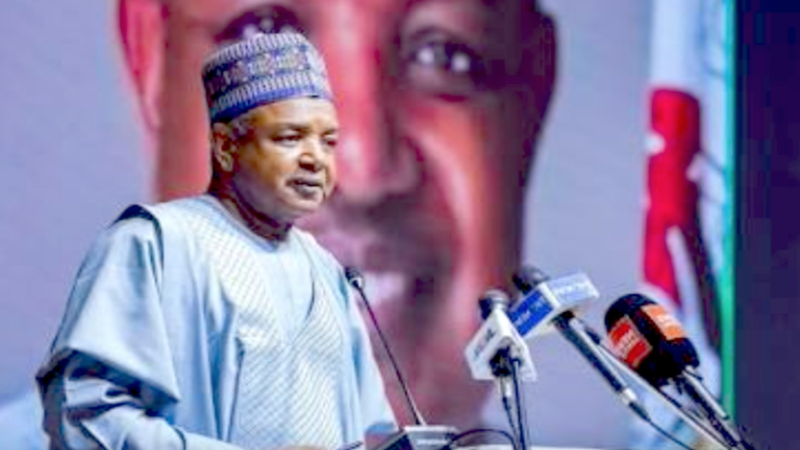
The Minister of Budget and Economic Planning, Senator Abubakar Atiku Bagudu, has urged Nigerians to demand greater accountability from state and local governments over the increased revenues accruing to them following the economic reforms of President Bola Ahmed Tinubu.
Bagudu said President Tinubu was taking the political “bullets” for difficult economic decisions whose financial benefits were now being shared across the three tiers of government.
The Minister made the remarks in Abuja while presenting the Federal Government’s Nigeria’s Reform Scorecard: The Benefits, Costs and Harms Prevented, an assessment of the economic reforms introduced by the Tinubu administration.
He said Nigerians should look beyond the Federal Government when assessing the impact of the reforms, noting that a substantial portion of the additional revenue generated since the removal of the petrol subsidy had accrued to states and local government areas.
According to figures presented by the Minister of Finance and Coordinating Minister of the Economy, Taiwo Oyedele, subsidy savings between June 2023 and December 2025 amounted to N15.8 trillion.
Of the amount, N5.4 trillion accrued to the Federal Government, while N10.4 trillion was shared by states and local governments through the Federation Account.
Bagudu consequently called on citizens to scrutinise how the increased allocations were being utilised by sub-national governments.
He acknowledged that Nigeria was still far from its desired economic destination, describing the ongoing transformation as “a work in progress.”
The Minister also stressed the need to improve the country’s revenue-to-GDP ratio, arguing that Nigeria’s population and economic potential were not reflected in the size of its national budget.
He said the country inherited one of the world’s weakest revenue bases and needed stronger domestic revenue mobilisation to sustainably finance infrastructure, security and social interventions.
The Federal Government’s reform scorecard indicated that Nigeria’s tax-to-GDP ratio had risen from below 10 per cent before the reforms to about 12.5 per cent.
Bagudu further disclosed that the Tinubu administration inherited more than $6 billion in unpaid petroleum import obligations, which he said contributed significantly to the difficult fiscal situation.
He explained that the Nigerian National Petroleum Corporation had previously been compelled to borrow funds to finance petroleum imports, highlighting the financial burden associated with the former petrol subsidy regime.
The scorecard stated that the government mobilised N20.4 trillion in incremental resources between June 2023 and December 2025. This comprised N5.4 trillion in subsidy savings accruing to the Federal Government, N3.1 trillion in incremental revenue and N11.9 trillion in additional borrowing.
The government, however, said the additional resources were largely deployed to meet rising expenditure obligations.
According to the Finance Ministry, the Federal Government recorded N30.64 trillion in incremental expenditure, including N9.39 trillion for wage adjustments, minimum wage increases and allowances, N9.37 trillion for external debt service arising from exchange-rate depreciation, and N6.47 trillion for strategic infrastructure.
The government acknowledged that the reforms had imposed significant costs on Nigerians, particularly through higher petrol prices and interest rates.
Oyedele said petrol prices had risen from about N185 per litre before the reforms to between N1,100 and N1,400, while the Monetary Policy Rate increased from 18.5 per cent to 26.5 per cent.
He nevertheless argued that maintaining the previous system could have produced even more severe consequences, including petrol shortages and black-market prices exceeding N3,000 per litre.
The government also pointed to improvements in some macroeconomic indicators, including stronger foreign reserves, increased market capitalisation and improved GDP growth.
Gross foreign reserves, according to the scorecard, increased from about $35 billion to $52.5 billion, while real GDP growth rose from 2.31 per cent in the first quarter of 2023 to 3.89 per cent in the first quarter of 2026.
However, the Federal Government admitted that improvements in macroeconomic indicators had yet to fully translate into improved household welfare, identifying poverty reduction and household recovery as unfinished business.
The scorecard further claimed that 27 states were unable to reliably pay salaries in 2023, compared with none in 2026, attributing the improvement partly to increased resources available to sub-national governments.
Bagudu said the next phase of the reform programme would require greater cooperation between the Federal Government, states and local governments to ensure that increased revenues translate into tangible improvements in the lives of Nigerians.
He said the government would continue to focus on infrastructure, security, agriculture and other interventions aimed at easing the burden of the reforms while strengthening Nigeria’s fiscal capacity.
The Minister's position echoes earlier arguments from the Presidency that increased Federation Account allocations have created greater fiscal space for states and local governments to finance infrastructure, salaries and social programmes.
Despite the government’s defence of the reforms, the measures remain politically contentious, with concerns over the cost-of-living crisis and household purchasing power continuing to shape public debate.
Share this story
Get updates on WhatsApp
Subscribe to receive selected updates from Media Gate News Online. We only use your number for this publication, and you can unsubscribe later.